


OGÉR JournalBlack tie9 min read
Beneath the address on the invitation sits a single line, and it decides your evening: black tie. Two words that summon an entire wardrobe, from the silk on the lapels to the shine on the toes of your shoes. Understand them, and there is nothing left to think about on the night itself. That is the whole point of a dress code: the clothes recede, and the company remains.
I. Black tie, white tie and what to wear to a gala
Formal eveningwear in Europe follows a clear hierarchy. At the top sits white tie, "cravate blanche" in French and simply "tails" in England. It is the dress code of state banquets, court balls and the most ceremonial evenings, and it leaves almost no room for interpretation. One step below is black tie, or "cravate noire": the dress code of the gala, the anniversary dinner, the premiere and the college ball. Another step down is the dark lounge suit with a tie, which we describe on our page on the tenue de ville dress code.
If an invitation simply says "gala" or "formal evening dress", black tie is almost always what is meant. "Black tie optional" means that a tuxedo is welcome and a dark suit with a tie is also acceptable. If in doubt, ask your host. That is never a faux pas; arriving underdressed is.
| Dress code | Jacket | Shirt | Tie | Shoes | When |
|---|---|---|---|---|---|
| White tie | Black tailcoat, peak lapels faced in silk; white piqué waistcoat | White, stiff piqué front, wing collar | White piqué bow tie | Patent oxfords or opera pumps | State banquet, court ball, very formal dinner after 6 pm |
| Black tie | Black or midnight blue dinner jacket, silk facings, one button | White, pleated or piqué front, double cuffs | Black silk bow tie | Patent or highly polished oxfords | Gala, ball, anniversary dinner, premiere |
| Gala | Usually black tie; white tie only if stated | As for black tie | Black bow tie | Patent shoes | Invitation mentioning a gala or formal evening dress |
| Creative black tie | Tuxedo, velvet dinner jacket or a variation in colour | White dress shirt or fine rollneck | Bow tie, also in colour or velvet | Patent shoes or velvet slippers | Festive evening with room for personality |
| Tenue de ville | Dark lounge suit | White or pale blue | Tie | Black oxfords | Reception, business dinner, ceremony |
A concise definition of each code can be found on our black tie page. This article goes one layer deeper: into the tuxedo itself, piece by piece.
II. The anatomy of the tuxedo
The dinner jacket
In much of Europe the tuxedo is still called a "smoking", after the velvet smoking jacket into which Victorian gentlemen changed after dinner for a cigar. The modern dinner jacket is black or midnight blue, with lapels faced in silk. Satin gives a soft sheen; grosgrain, a ribbed silk, is more matte and quietly restrained. Two collar shapes are classic. The shawl collar runs in a single rounded line from neck to button and reads as soft and elegant. The peak lapel, its points angled upwards, is sharper and more formal. The notch lapel of an ordinary suit, strictly speaking, does not belong here.
The jacket fastens with one button, ideally covered in the same silk as the facings. The pockets are jetted, without flaps: flaps are for daytime. At the back, no vent is the most traditional choice; double vents allow freedom of movement and fall neatly when you put your hands in your pockets. A single centre vent comes from riding and has no place in eveningwear.
The trousers
The trousers are cut from the same cloth as the jacket and carry a braid: a silk stripe along the outer seam, in the same finish as the facings. There are no belt loops, because a belt breaks the line between jacket and trousers. Evening trousers are worn with braces, buttoned inside the waistband, or have adjustable side tabs. Turn-ups never belong on them.
The dress shirt
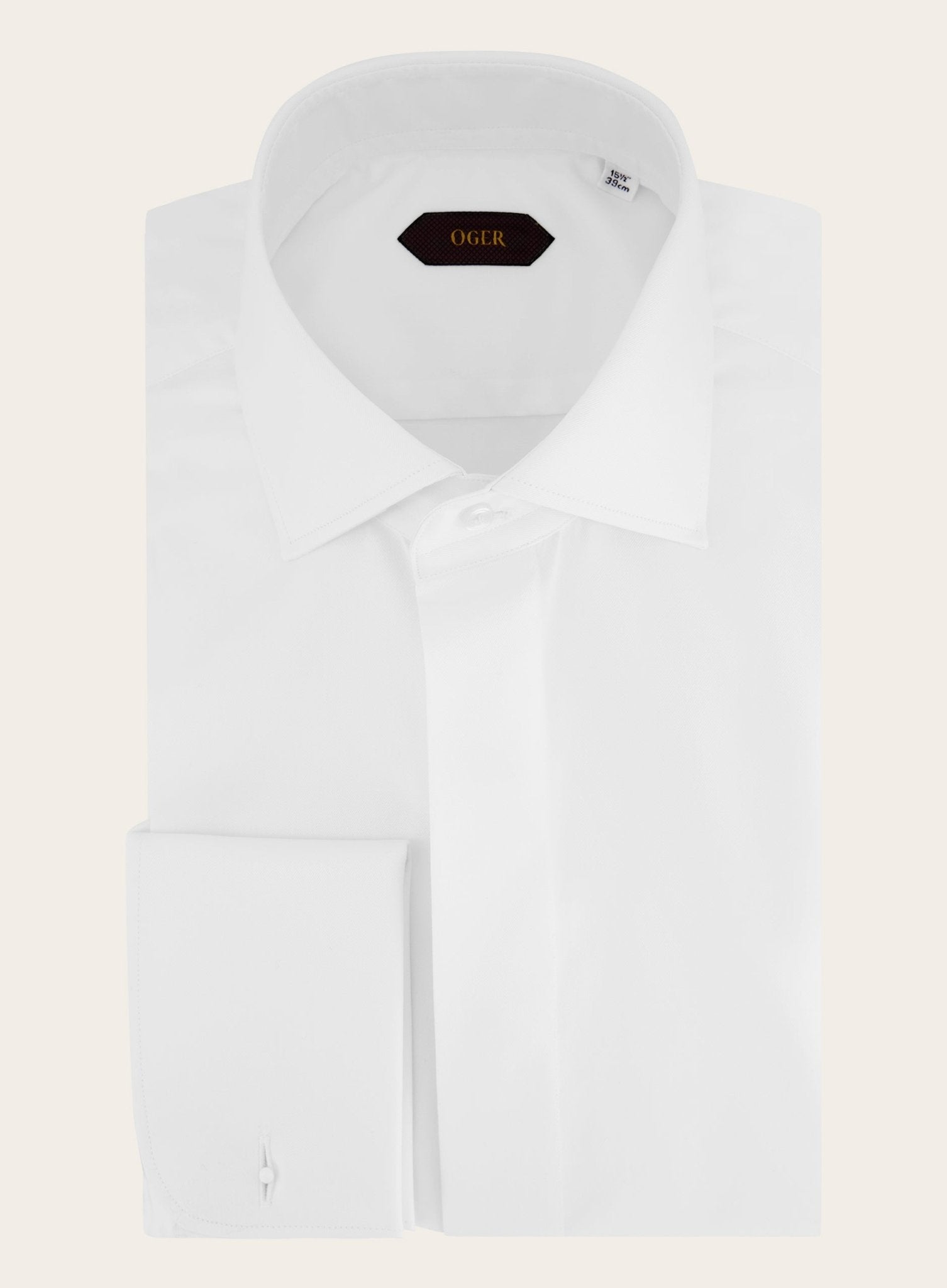
The dress shirt is white, always. The front is pleated or made of piqué, a textured cotton also known as marcella. With black tie a turndown collar is the usual choice; the wing collar belongs, strictly speaking, to white tie, although you will see it under a dinner jacket too. The cuffs are double, closed with cufflinks, and the front often fastens with studs or a concealed placket. The OGÉR tuxedo shirt is made for exactly this combination.
Bow tie, cummerbund or waistcoat
The bow tie is black silk, ideally in the same texture as the lapels. Choose one you tie yourself. A pre-tied bow is too perfectly symmetrical and gives itself away across the room; a hand-tied bow has the slight irregularity that shows a hand was involved. You will find the silk bow tie among our ties and bow ties. Around the waist you wear a cummerbund, pleats facing upwards, or a low-cut evening waistcoat. Both serve the same purpose: to cover the point where shirt meets waistband, so that the silhouette stays unbroken.
Shoes, socks and pocket square
The choice of shoes is brief. Patent leather is the standard: oxfords with closed lacing and a plain toe, without broguing. Highly polished black calf oxfords are a dignified alternative, and the opera pump with a grosgrain bow is the most traditional form of all. The OGÉR patent leather shoes complete the picture. Socks are black silk and over the calf, so that no skin shows when you sit. In the breast pocket goes a white pocket square in linen or silk, folded straight or loosely puffed. A matching set of bow tie and pocket square looks planned, which is precisely what you want to avoid.
“A good tuxedo does not draw attention to itself. It reveals the man who wears it.”
OGÉR Journal
III. How a tuxedo should fit
A tuxedo is less forgiving than a suit. The dark cloth and gleaming lapels expose every crease and every flaw under the lights of a ballroom. Watch five points. The shoulder seam ends where your shoulder ends. The sleeve shows one to one and a half centimetres of shirt cuff, enough to reveal the cufflinks. The jacket covers the seat. The button sits at or just above the natural waist, so that the V of the lapels is long and lean. And the jacket closes without pulling: if you see an X-shaped crease around the button, it is too tight.
The trousers sit higher on the waist than those of an ordinary suit, so that no shirt appears between cummerbund and waistband. The hem has no turn-up. Choose no break or a slight break: the trouser just touches the instep and runs a little longer at the back. A narrow, modern line suits most men, provided it never strains. The slim-fit tuxedo in wool follows that lean cut; wool has always been the cloth of eveningwear, as it drapes supplely and holds its shape all night. More models can be found in the OGÉR tuxedo collection.
IV. Variations: midnight blue, velvet and the white dinner jacket
Midnight blue
Midnight blue is no passing fashion but a classic of the 1930s. Under artificial light a deep midnight blue often looks darker and richer than black, which can turn greenish or grey under lamps. The facings stay black, as do the bow tie and shoes.
The velvet dinner jacket
In winter, a velvet dinner jacket is the most elegant way to give black tie a face of its own. It is a direct descendant of the original smoking jacket, and its deep pile catches candlelight in a way no wool can match. Wear it with black evening trousers with a braid, a white dress shirt and a black bow tie. The slim-fit velvet jacket is part of the Fall Winter 26 collection and suits the season in which most galas take place.
The white dinner jacket
A white or ivory dinner jacket belongs to warm climates and summer evenings outdoors: a gala on the Riviera, a garden party that turns formal after sunset. It is always worn with black evening trousers. In a Dutch ballroom in November it strikes a false note; on a seaside terrace in July it is exactly right.
Creative black tie
If the invitation asks for creative black tie, the classic foundation may take a personal turn: a bow tie in colour or velvet, a dinner jacket in bottle green or burgundy, a fine rollneck beneath the jacket. The formal structure remains; only the accents change.
V. Common black tie mistakes
Most mistakes come from habit: dressing for an evening as one would for the office. A belt instead of braces is the most common. Then come the pre-tied bow tie, the long tie worn with a tuxedo and the black shirt, which suggests the waiting staff rather than a guest. Trousers that are too long, or have turn-ups, make the whole silhouette heavy.
Less visible but just as distracting: a cummerbund with its pleats facing down, business shoes with rubber soles, short or coloured socks, and a large sports watch under the cuff. Traditionally, black tie calls for a slim, simple watch or none at all. And when you stand, the jacket is buttoned; seated at table, the button may be undone. Weddings sometimes follow their own rules, from morning dress to tuxedo; you can read about them on our page on wedding attire at OGÉR.
VI. The coat over the tuxedo
Most galas fall between October and March, and that calls for an overcoat. The rule is simple: dark, long enough to cover the dinner jacket entirely, and made of a cloth that matches the rest of the evening. A short jacket or a quilted coat undoes the look at the very moment you are most seen: on arrival.
The Mandelli cashmere coat with stand-up collar from the Fall Winter 26 collection shows how it is done. Cashmere falls softly over the shoulders of a dinner jacket, and a stand-up collar closes high around the neck without crushing the bow tie. Finish with a white silk scarf and leather gloves, and you will arrive as composed as you leave.
VII. Tailoring: a tuxedo that is yours alone
A tuxedo is not worn every week, but it is worn on the evenings you remember years later. That is exactly why it rewards being made for you. OGÉR is a family business with more than thirty years in menswear and tailoring. Its made-to-measure service covers suits, jackets and shirts, with a choice of the finest Italian cloths and your own decisions on buttons, construction and details. Delivery follows within six weeks.
For a tuxedo, those are precisely the decisions that matter: shawl collar or peak lapel, satin or grosgrain, trousers cut high enough on the waist for your cummerbund. Have the dress shirt made to measure at the same time, so that collar and cuffs align exactly with the sleeve length of the jacket. Count back from the date of your gala and book well ahead of those six weeks. You can arrange an appointment for made-to-measure at OGÉR online, choosing location, date, time and advisor.
Torn between a shawl collar and a peak lapel, or between a tuxedo from the collection and made-to-measure? The OGÉR Personal Advisors will help you in the four OGÉR stores in Amsterdam, Rotterdam, The Hague and Antwerp. Bring your invitation: from the dress code, the season and the venue they can tell what you need. Book a made-to-measure appointment or visit one of our stores.
The edit · Black tie
Shop the tuxedo collection



Frequently asked questions
What is the difference between black tie and white tie?
Black tie means a tuxedo: a dinner jacket with silk facings, trousers with a braid, a white dress shirt and a black bow tie. White tie is more formal: a black tailcoat, a white piqué waistcoat, a wing-collar shirt and a white bow tie. White tie is worn at state banquets and court balls; black tie at most galas.
What should a man wear to a gala?
In the Netherlands and Belgium, a gala dress code usually means black tie: a tuxedo with a black bow tie, white dress shirt and patent shoes. If the invitation states white tie, a tailcoat with a white bow tie is expected. If in doubt, ask your host.
Which shirt do you wear with a tuxedo?
With a tuxedo you wear a white dress shirt with a pleated or piqué front, double cuffs and cufflinks. A turndown collar is the usual choice for black tie; the wing collar strictly belongs to white tie.
Which shoes go with a tuxedo?
Patent leather oxfords with closed lacing and a plain toe are the standard with a tuxedo. Highly polished black calf oxfords and opera pumps are classic alternatives. Wear them with black silk socks.
Do you wear a belt with a tuxedo?
No. Classic tuxedo trousers have no belt loops and are worn with braces or adjustable side tabs. The waist is covered by a cummerbund or an evening waistcoat.
Can OGÉR make a tuxedo to measure?
Yes. OGÉR makes suits, jackets and shirts to measure, with a choice of the finest Italian cloths, buttons, construction and details. Delivery follows within six weeks. Appointments can be made at oger.nl/pages/made-to-measure.
Written by the OGÉR Editor in Chief